Private Label Perfume for a Middle East Launch: The Buyer Checklist
Private label is the fastest route to a perfume line, but in the Middle East it is not the cheapest one by accident: heat, import documentation and local scent preferences each add a decision that a buyer has to make before the deposit, not after. The brands that launch smoothly are the ones that settle five things up front — the base, the bottle, the closure, the claim set and the paperwork. Everything else can be adjusted later at little cost.
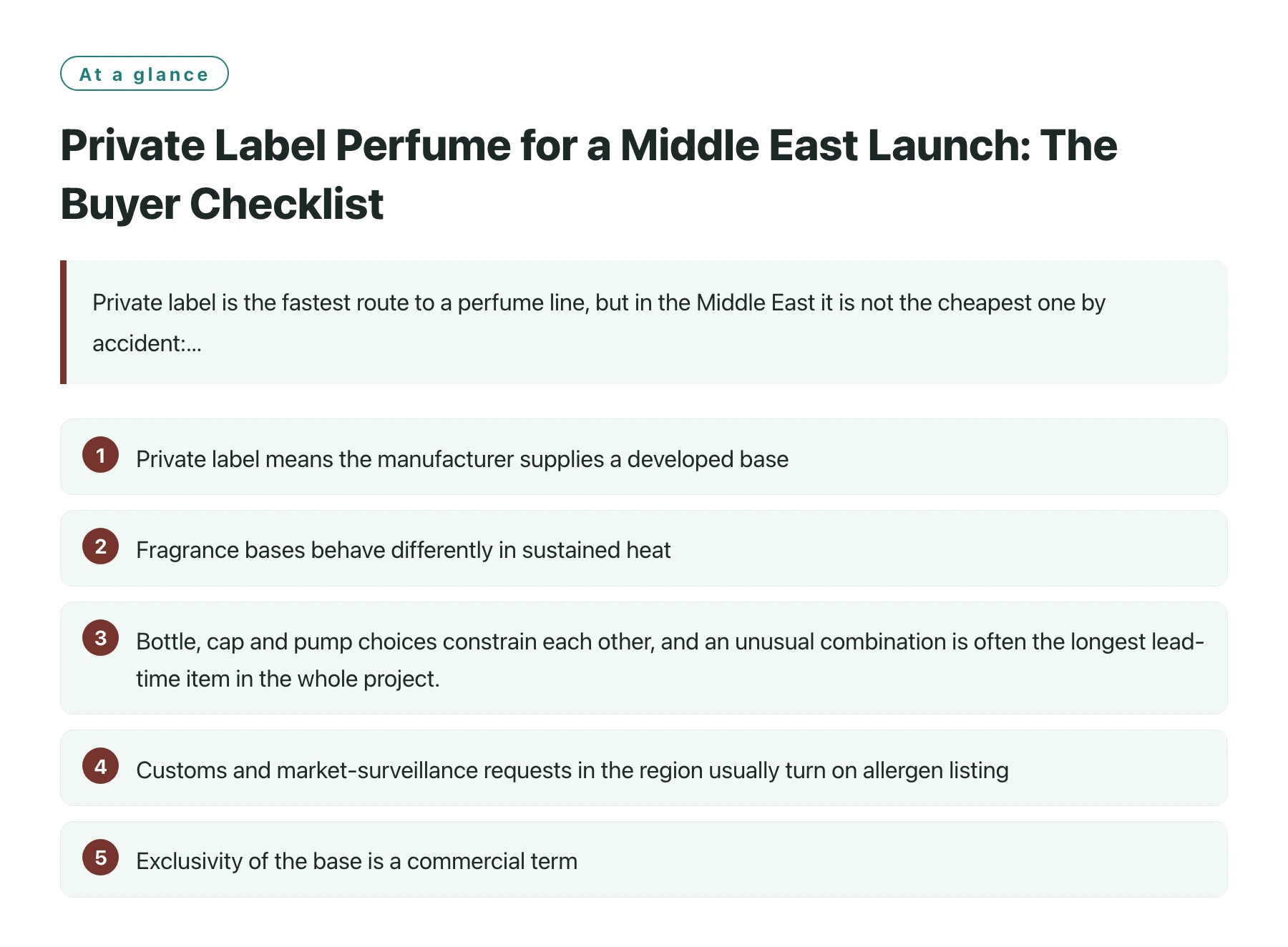
Key takeaways
- Private label means the manufacturer supplies a developed base, so the buyer's real work shifts from formulation to selection and compliance.
- Fragrance bases behave differently in sustained heat; a scent approved on a mild afternoon can read flatter and shorter in a Gulf summer unless it was tested that way.
- Bottle, cap and pump choices constrain each other, and an unusual combination is often the longest lead-time item in the whole project.
- Customs and market-surveillance requests in the region usually turn on allergen listing, safety documentation and Arabic labelling, not on the scent itself.
- Exclusivity of the base is a commercial term, not a default; if it matters to the positioning, it has to be purchased and written into the agreement.
Most private label conversations start with a photograph of a bottle and a question about price per unit. That is a reasonable place to start socially and a poor place to start commercially, because the number depends on decisions that have not been taken yet.
The Gulf and the wider Middle East are attractive for a first launch: fragrance is a routine purchase, gift-giving is seasonal and generous, and consumers are willing to try new houses. They are also unforgiving of products that were designed for a cooler, less regulated market.
This checklist is written for the buyer who is doing this for the first time and wants to avoid the four or five decisions that are expensive to reverse.
Start with the base, not the bottle
In a private label arrangement the manufacturer already holds developed bases, and the buyer selects from them. That changes the economics: development cost falls away, but so does uniqueness, unless exclusivity is negotiated. The first useful question is therefore not "what can you make" but "what do you already make, and which of those is unclaimed in my market".
Ask for the base list with a short description of each: family, rough intensity, recommended dosage range and whether it is currently in production for another client. A base that is already running in production is cheaper and faster to order, because the raw materials are already qualified and in stock. That is not a compromise; it is leverage. Buyers who want to see how that selection stage has played out for other launches can read the Xuelei case studies before the first call, and a manufacturer such as Xuelei private label perfume manufacturer in China will normally share its base list with the recommended dosage range attached rather than leaving you to guess.
Test the base the way your customer will wear it
Heat changes the way a fragrance reads. Volatile top notes burn off faster, heavier amber and oud materials come forward, and a composition that felt balanced in an air-conditioned room can feel flat outdoors. Ask for trials on skin and on fabric, and evaluate them after two and four hours rather than on the first spray.
If the launch market includes the Gulf, test at a dosage at least as high as you intend to sell and preferably test a slightly stronger version as well. Performance complaints in this category are almost always about longevity, and longevity is cheaper to fix before the order than after.
Decide whether the base needs to be yours alone
Exclusivity is priced in one of three ways: a higher unit cost, a minimum annual volume, or a one-off fee for the formula or the registration. Whichever route is used, the term, the territory and the duration belong in the agreement. A useful companion read on how ownership and registration questions are handled is the summary of how brands Xuelei has manufactured for approached it.
If exclusivity is not affordable at launch, the honest alternative is to compete on packaging, price and distribution rather than on scent, and to plan a second, exclusive edition once volume supports it.
Four choices that are hard to reverse later
| Decision | Why it locks in early | Practical test |
|---|---|---|
| Concentration and dosage | It sets viscosity, fill behaviour and the raw material cost per unit | Confirm the dosage range in writing and get a fill trial before approving artwork |
| Bottle and cap pairing | A non-standard neck and closure combination needs tooling and a longer lead time | Receive a filled, assembled sample, not a separate bottle and cap |
| Labelling language | Arabic and English text usually need a different layout, not a translation of the same one | Have the artwork checked by someone who reads the destination market's requirements |
| Claim set | Words such as natural, alcohol-free or long-lasting carry evidence obligations | List every claim and ask which document supports it in the destination market |
None of these four can be fixed by a better price. They can only be fixed by a new order, which is why they belong in the first conversation.
Packaging for heat, light and shipping
Perfume is a fragile product in transit. Alcohol-based liquids expand, pumps can seep, and a carton that was fine in a temperate warehouse can soften in a container parked in the sun. The practical measures are unglamorous: a closure with a proven seal, an inner fitment that stops the bottle moving, and a carton board that does not deform under load.
Ask what the manufacturer's standard export packing looks like and whether it has been used for the destination region before. This is also the moment to settle whether the product ships as a finished consumer unit or as a bulk concentrate to be filled closer to the market — a decision that changes duty, lead time and the amount of capital tied up in inventory.
Set a shelf-life expectation you can defend
Buyers are often asked for a shelf life before anyone has run the storage trial. The defensible answer is usually a documented stability result rather than a round number. If the pack contains a decorated bottle or a printed label, ask how the decoration holds up under the same conditions, since failure there is more visible than any change in the juice.
Plan the second SKU before the first order
A launch rarely stays at one product. If a smaller travel size or a gift set is plausible within a year, mention it now: the closure, the carton and even the concentrate dosage can often be chosen so that the second SKU reuses them. Retrofitting a family of products onto a single, arbitrarily chosen bottle is a common and avoidable expense.
Documentation is part of the product
For most Middle East destinations, the paperwork travels with the goods and is checked at the border and, increasingly, at the point of sale. A supplier that exports regularly will keep a standard pack ready, and asking to see it is a fast, concrete way to judge operating experience. Some buyers arrange a market visit before signing and combine it with a look at the regional fragrance scene — a house that also operates the museum of scent in Guangzhou tends to have a physical operation you can walk through rather than a showroom alone.
Cosmetic products placed on the EU market, for example, require the responsible person to hold a product information file and to list allergens on the label; these requirements are documented publicly, and the same habit of keeping a complete file is what makes a GCC-bound shipment easy to clear [1]. The scent in the bottle is rarely the reason a first shipment is held.
Ask for the allergen and restriction position of the base
The International Fragrance Association publishes the standards library that most of the industry uses to set maximum use levels for restricted materials, and a responsible manufacturer will be able to say how a given base sits against it [2]. This is not a marketing document; it is the number that determines whether a formula can be sold at all in a given market.
Confirm how the halal requirement is addressed
Halal expectations vary by market and by retailer. A manufacturer that holds halal recognition will have a defined position on alcohol content, animal-derived materials and cross-contamination, and can describe it in one page. Buyers should ask for that page rather than assume it, and should confirm that it covers the specific product being ordered.
Sources
- European Commission: Cosmetics in the EU —— The European Commission's overview of EU cosmetics rules, including the responsible person, product information file and safety report requirements.
- IFRA Standards Library (International Fragrance Association) —— The IFRA Standards Library lists the restrictions the fragrance industry applies to individual fragrance ingredients, based on safety assessments; it is the reference point for compliant fragrance formulation.
Frequently asked questions
How long does a first private label perfume order usually take?
The scent selection and sample round is typically the shortest part. Bottle, cap and carton sourcing, artwork approval and the stability check usually set the timeline, and any component that needs new tooling adds several weeks on its own. Ask for the lead time split by stage rather than as a single number.
Do I need my own formula for a private label launch?
No. Private label uses bases the manufacturer has already developed, which is why entry cost and time are lower. If the base needs to be reserved for your brand alone, that is a separate commercial term with its own price and duration.
Is alcohol-free perfume easier to sell in the Middle East?
It depends on the market and the channel. Some buyers prefer alcohol-free formats for religious or skin-sensitivity reasons, others find performance expectations differ. The practical step is to test both formats with the actual target consumer group rather than deciding from a general assumption.
What should I check on the first production sample?
Fill weight against the declared volume, the seal and pump behaviour after a short storage period, the decoration position against the approved artwork, and the scent after a few days of rest. Approve a retained physical sample with a date and batch reference so that later deliveries have something concrete to match.
Should I order the minimum quantity for the first run?
Usually yes, if the minimum still allows a real market test. The first order exists to confirm that the process, the pack and the paperwork work; the second order is where volume becomes worth negotiating.